Your AI policy isn’t downloaded, it’s grown.
Co-design it with your staff, pupils and parents.

Other boilerplate policies are available. But no other policy will be co-designed with the people that matter to you most.
Pro-active schools are gathering expertise and policy templates on AI-adoption. However, many boilerplate policies available for download feel 'one-size fits none' - they are cascaded, not co-designed.
Our workflow uses survey and sentiment from pupils, staff and parents to compile custom school policies that have higher relevance, pupil-compliance and communication impact.
What do you know, and what are you assuming?
Five questions about AI in your school. One minute. Answer for your school as it is today, not as the policy says it should be.
- You see your result straight away. No email needed.
- Your answers stay in your browser unless you ask for the summary.

Figures: Public First poll of 4,021 11–24-year-olds in England, August 2026, for Seldon and Bunting, “Britain’s Greatest Education Opportunity Ever”. Guidance: DfE, Generative AI in education (August 2025); JCQ, AI Use in Assessments (April 2025). This is a self-check, not a compliance audit.
Survey. Compile. Report. Explain.
-
1
Survey
A short survey each for staff, pupils and parents. Ten questions at most: what they use AI for, what they think is fine for homework, and what worries them.
-
2
Compile
The three sets of answers are brought together and set against current DfE and JCQ guidance. See where the groups agree, where they differ, and where your own estimate is out. Reported by year group and audience only, with small groups hidden, so no one can be identified.
-
3
Report
We go through the leader report and the next-term priority plan with your leadership team. Discuss what the answers show, question anything that does not match what you see, and refine the actions before the charters are written.
-
4
Explain
Share the one-page pupil and parent charters, and cascade the AI policy and subject-specific goals to staff. Everyone in the building hears the same thing, in words that came from them.
FOUR DOCUMENTS TO SHAPE A CONFIDENT POSITION AND BUILD PUPIL/PARENT SUPPORT.
Leader report
What each group does and thinks about AI, where they differ, and the evidence that you consulted. Written so you could hand it to governors unedited.
Next-term priority plan
One page. Three priorities at most, each with an action, an owner and a date. Any JCQ requirement not yet in place goes first.
Parent charter
One page, plain English. What the school will do, what it asks of families, and what pupils have agreed to. AI and homework only.
Pupil charter
One page, in pupils’ words. What’s fine, what’s fine if you say so, what’s not OK, and how to say you used AI.
UNDERSTAND YOUR SCHOOL'S USAGE, ATTITUDES AND OPPORTUNITIES.
Sentiment and reliance visualised by year group
How pupils feel about AI, set beside how much they lean on it, one year group at a time. In this sample, reliance climbs every year while confidence dips in the exam years.
Show these numbers as a table
| Year group | Positive about AI | Rely on it |
|---|---|---|
| Year 7 | 72% | 13% |
| Year 8 | 70% | 17% |
| Year 9 | 68% | 24% |
| Year 10 | 61% | 34% |
| Year 11 | 56% | 43% |
| Year 12 | 62% | 49% |
| Year 13 | 66% | 54% |
Application and opportunity-size by subject area
Where AI is already part of homework, and where there is room to use it well. The darker bar is use now, the lighter bar is the potential, and the gap between them is the opportunity.
Show these numbers as a table
| Subject area | Use now | Potential | Gap |
|---|---|---|---|
| Languages | 38% | 74% | 36 |
| Science | 49% | 80% | 31 |
| Humanities | 41% | 69% | 28 |
| Maths | 52% | 78% | 26 |
| English | 46% | 71% | 25 |
| Creative arts | 17% | 39% | 22 |
| Computing | 63% | 82% | 19 |
| PE | 9% | 24% | 15 |
What you can hold us to.
Six commitments that apply to every survey run. Each one is something you can check.

Mapped to the guidance you answer to
Every expectation in your documents is labelled must, should or could, and names its source: DfE’s Generative AI in education and JCQ’s AI Use in Assessments.
Anonymous, and reported in groups
No names and no log-ins. Results are shown by year group or audience only, and small groups are hidden, so no one can be picked out.
Written from your school’s answers
Your documents come from your own survey results and the cited guidance. Nothing is lifted from another school’s policy.
You make the close calls
Where staff, pupils and parents agree, it goes into the charters. Where they don’t, your leadership team gets the figures and decides.
Every figure shows its limits
Each report says how many answered, who didn’t, and what a self-reported answer can’t prove. It is evidence of consultation, not legal advice.
Dated, and rebuilt every year
Guidance changes. Every source carries its version and date, and your documents are rebuilt at each annual re-run.
Already got a policy? Good. Keep it.
Most schools have one, and it was probably fine on the day it was written. What it can’t do is tell you how your pupils are using AI, show that you asked parents, or update itself when the guidance changes again. We start from the policy you have and put the evidence underneath it. Nothing wasted.
4 week process, £1299.
Two week consultation surveys using our platform. Automatic-compilation and personal delivery to your leadership. Two weeks supported charter rollout.
One licence. Every school.
See which of your schools are ready and which aren’t, on one page. Give the board the consultation evidence in one report, instead of chasing twelve heads for twelve Word files.
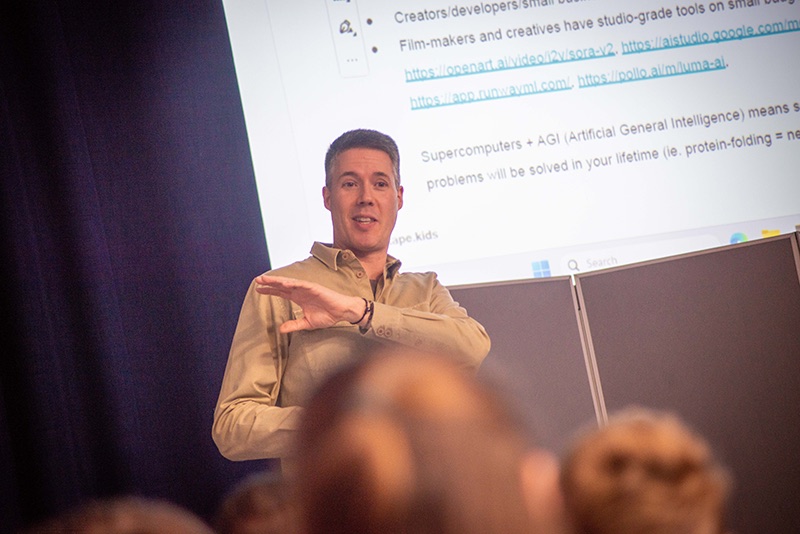
I’M STUART. TECHNOLOGIST, ENTREPRENEUR & AI-COACH.
I've spent over 20 years as a user-centred design leader working on complex public services and digital tools in regulated spaces. I've been working in schools with my AI-mindset framework and PSHE toolkit Lifetape®.
Harmonise the use of AI across your school. Bring staff, pupils and parents with you.
Early access schools get their first surveys and reports free. Register your interest.